
Moroccan architecture is not one style you can copy with an arch and a fountain. It is a set of built answers, different in Fez, Marrakech, the South and Casablanca, to heat, privacy, water and living together. This guide separates those answers, then shows what a contemporary project can take from them without turning a house into a set.
It was rewritten in October 2026 by Mr Mine Deco, an interior architecture studio in Marrakech, from houses, riads and hospitality projects in Morocco. It sits beside our pages on the riad and on the work of an interior architect.
What “architecture of Morocco” actually covers
The phrase covers the ways of building that followed one another in the country: medina houses, religious and civic buildings of the imperial cities, earthen architecture of the South, twentieth-century blocks and recent construction. Arab, Amazigh, Andalusi and later European influences are visible in it. They do not produce a closed catalogue.
A search usually lands on monuments. The Koutoubia, Hassan II mosque or a Fez madrasa explain a history. They do not explain how a house holds the heat, or what can reasonably be changed in a courtyard. For an owner, Moroccan architecture starts at the scale of the plot: the entrance, the court, the thickness of the walls, the roof, the light.
Five families that should not be mixed
| Family | Where you recognise it | What it organises |
|---|---|---|
| Medina house and riad | Marrakech, Fez, Meknes, Rabat, Essaouira, Tetouan | Privacy, court, rooms in sequence, a lived-on roof |
| Earthen architecture | Draa and Dades valleys, ksour, kasbahs | Mass, shade, few openings to the outside |
| Learned buildings | Mosques, madrasas, foundouks, palaces | Geometry, painted wood, zellige, carved plaster |
| Twentieth-century city | Casablanca, central Rabat and Tangier | Apartment block, art deco, concrete, a street façade |
| Contemporary project | Villas, hotels, camps, rehabilitations | Present-day comfort, a clear structure, chosen craft |
Mixing these families is the common mistake. A camp on the palm grove is not a riad. A villa in Hivernage is not a kasbah. Covering a 1970s flat in zellige does not make it a Fez house. Moroccan architecture is convincing when the gesture matches the building that is already there.
The courtyard is the main room
In a medina the street façade is often mute. The door is the event. Behind it, a bent passage stops the eye from crossing the house. Life is arranged around the court. A riad, in the strict sense, is that house when the court is a garden. In tourism, the word also means a guesthouse. Both meanings exist, and they should be separated before a purchase or a building site.
The court is not decorative empty space. Cool night air settles in it, the rooms draw on that air through the day, and warm air leaves at the top. It lights deep plots where a street window would give away privacy.

What changes from one city to another
In Fez, plots are often deep, galleries narrow, woodwork and zellige very present. An intervention has to accept steep stairs, uneven levels and walls that are not plumb. Our study of Riad Inaya started from that constraint: patio, spa, shop and roof, without erasing the house.
In Marrakech the court is often more generous, the roof is a real living room, and the garden shifts the palette. Renovation is as much about shading the patio as about keeping bedrooms quiet. The guide to renovating a riad in Marrakech goes into that sequence.
In Chefchaouen, the blue of the city should not decide the whole house. For the guesthouse we studied, blue stays a marker, held by wood, white and a roof open to the landscape. In the South, mass matters more than ornament. The camp in Agafay is not treated like a medina: shade, wind, dust and a cold night come first. In Casablanca and other twentieth-century districts, the question is the block, the ceiling height and a street façade that should be neither pasted over nor stripped of what it is.
Materials that carry the building
Rammed earth and mud brick give inertia. Tadelakt closes wet rooms without looking like standard tile. Zellige protects walls that take water and wear, and it builds a geometry. Cedar holds ceilings, doors and screens. Lime lets masonry breathe better than a sealed paint on a damp wall.
These materials fail when they are used as stickers. Tadelakt in a bathroom with no slope and no ventilation stains. Zellige chosen from a screen, never seen in Marrakech light, shifts. The craft is specific. It needs a drawing an artisan can build, and a sample checked on site.
What a contemporary project can take
Contemporary Moroccan architecture does not have to copy a palace. It keeps principles: a thickness between the street and the living room, a court that does climatic work, few materials but well made, a roof designed as a place. Present-day comfort is added openly: sound wiring, hot water, quiet between bedrooms, a kitchen that can be used.
That is interior architecture when structure and permits belong to a registered architect. Mr Mine Deco works at that level in Marrakech: drawings, materials, site and, when the brief includes it, turnkey delivery. Villa Prestigia shows the other side, a recent house where the Moroccan reference sits in proportion and material, not in a pile of motifs.
Common questions
Is Moroccan architecture the same as the “Moroccan style” in magazines?
No. Moroccan architecture is a set of buildings and principles tied to climate and city. Magazine style isolates objects: a lantern, a pouf, an arch. Those objects do not explain a house, and they do not renovate one.
Does a riad sum up Moroccan architecture?
No. The riad is a major domestic type in the medinas. Kasbahs, ksour, madrasas and twentieth-century buildings belong to the same larger story. Treating them as one produces pastiche.
Architect or interior architect for an old house?
As soon as a load-bearing wall, a floor, a roof or a permit is involved, a qualified architect is required. The interior architect organises use, non-structural partitions, light, materials and finishes. The two commissions coordinate. They do not replace each other.
Can these principles be used in a new villa?
Yes, if you take a principle rather than a costume: a court, a thickness, one material done properly, a clear relation between interior and garden. An arch stuck on an open living room is not enough.
The logical next step
The matching service and case studies
This guide comes out of our daily work. Here is the service it relates to, and two case studies that show it in practice.

 Case study
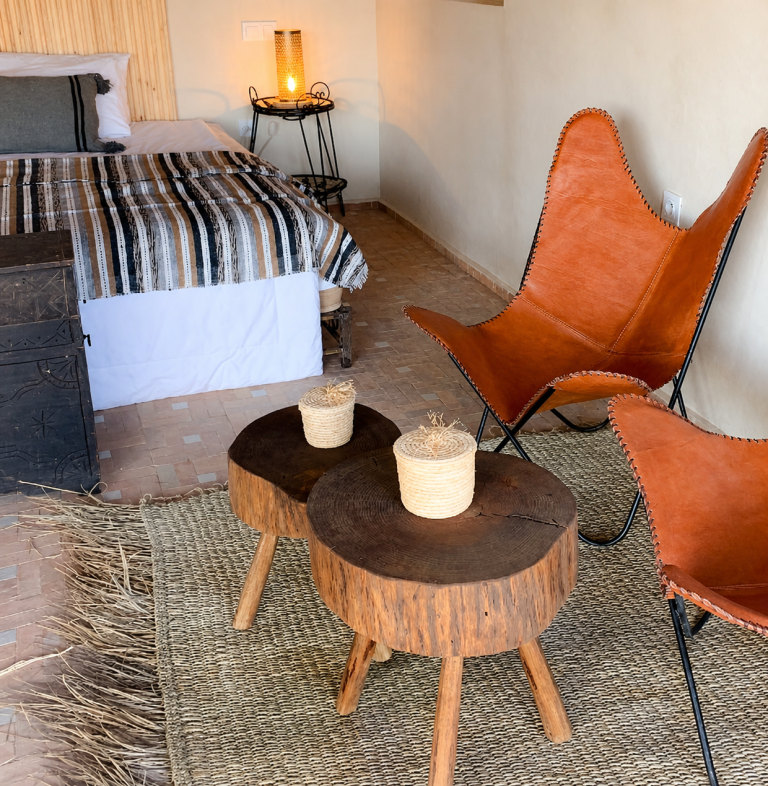
The Original Camp Agafay
Interior design and decoration of The Original Camp in Agafay: tents, restaurant and lounge areas created by Mr Mine Deco near Marrakech.
View the case study
Case study
The Original Camp Agafay
Interior design and decoration of The Original Camp in Agafay: tents, restaurant and lounge areas created by Mr Mine Deco near Marrakech.
View the case study


