
An interior architect designs how a place that already exists, or that has just come out of the shell, will actually be used. The work covers rooms, light, materials and furniture, so that people can live or work there. It does not, on its own, sign a building permit. This page describes the commission, separates it from the architect and the decorator, and says when it becomes necessary in Morocco.
Mr Mine Deco practises this in Marrakech, on apartments, villas, riads and places open to the public. The wider built context is Moroccan architecture.
What an interior architect does
The work starts with a survey and with plain questions: who sleeps here, who is received, where things are stored, which room is too hot at four in the afternoon, which wall must not be touched. Drawing follows. Layout plans, non-structural partitions, services as they appear in the project, lighting, floors, joinery, fixed or designed furniture. The aim is a coherent place, not a sequence of purchases.
On site, the interior architect turns those choices into instructions for the trades, checks samples in the real light and decides when a planned detail does not fit. That presence limits the usual gap between the picture and the room that is handed over. It does not replace the inspection office, the contractor, or the architect when structure is involved.
Architect, interior architect, decorator
| Architect | Interior architect | Decorator | |
|---|---|---|---|
| Subject | The building: structure, envelope, siting | Interior organisation and the finishes tied to use | Atmosphere, furniture, textiles, styling |
| May change | Load-bearing walls, roof, façades, within the commission | Non-structural partitions, wet rooms, lighting, fitted work | What is placed, hung and moved, without heavy technical work |
| Permission | Can prepare a permit file when qualified to do so | Does not file a building permit alone | Does not prepare a permit |
| Useful when | New build, upward extension, structural repair | Before an interior fit-out or renovation | When the plan already works and objects remain |
In Morocco the title of architect is regulated. Registration with the Order of Architects, and the ability to carry a permit, are not informal. An interior architect is not a lesser architect. It is a different responsibility. Mixing the two delays files and leaves load-bearing walls in the wrong hands. An opening, a floor or a façade needs the qualified person. For the rest of the place, the interior architect holds the thread.
How a commission runs
- 1. The brief.Uses, budget, calendar, what must stay. Without that frame, the drawing drifts into decoration.
- 2. The survey.Sizes, openings, heights, visible services, light at the hot hour. In a riad, levels often differ from one wing to another.
- 3. The sketch.One or two ways of organising the rooms. You judge circulation here, not cushions.
- 4. The project.Drawings, materials, light, and 3D views when the volume is hard to read. The file is what gets priced.
- 5. The site.Trades, sequence, checking details, handover. The scope is signed before, not in the middle.
Fees follow that extent. A consult visit, drawings only, or a commission through to handover do not cost the same. The 2026 benchmarks for Marrakech are in what an interior architect costs. The questions to ask before you commit are in how to choose an interior architect.
What Morocco changes
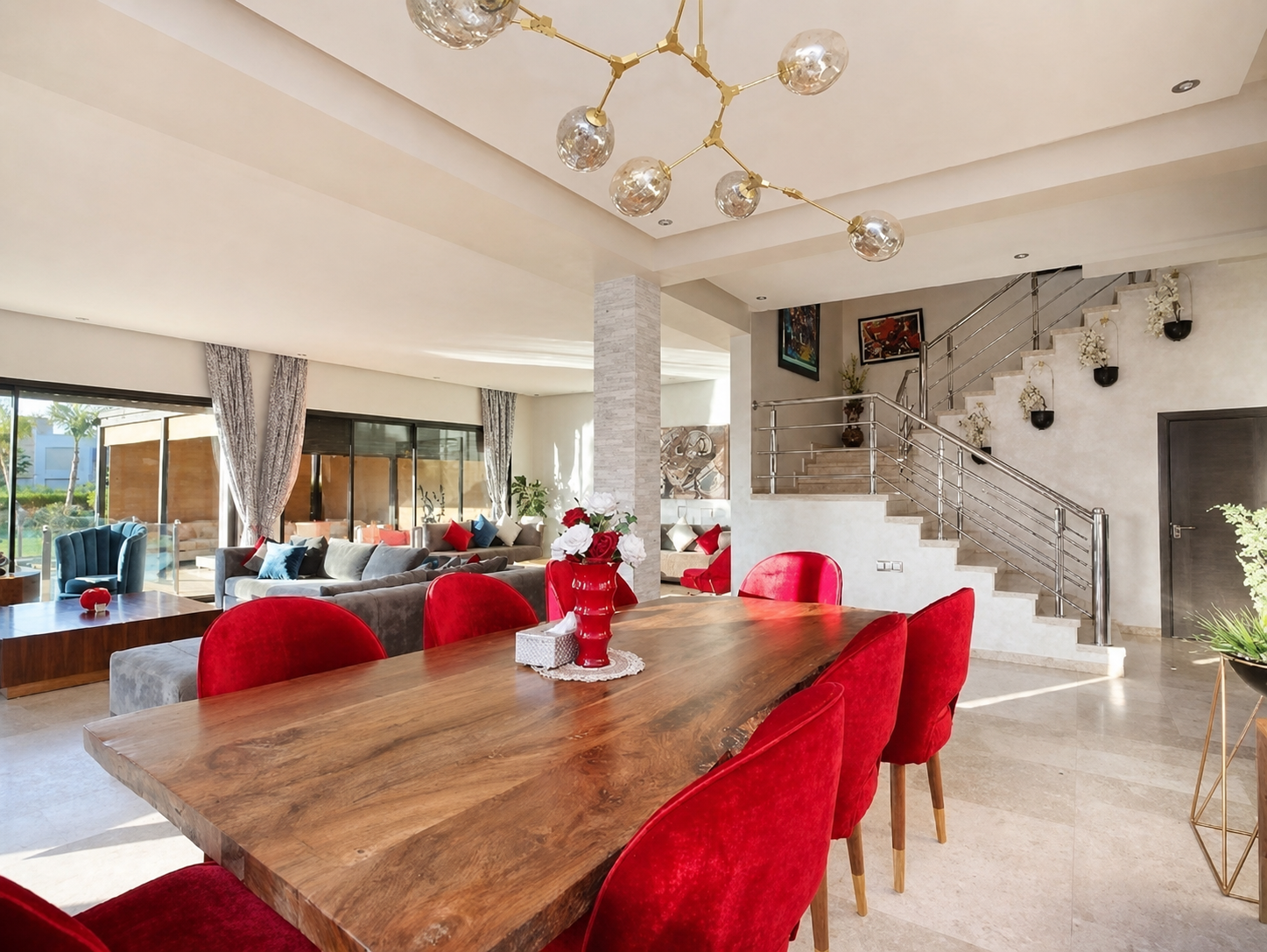
The same profession does not produce the same project in a Guéliz apartment, a new villa and a riad. The apartment needs storage, acoustics and a precise kitchen. The villa needs a relation to the garden and solar protection. The riad needs you not to break the court in order to gain one more bedroom.
Marrakech light is hard for much of the year. A colour chosen under a workshop tube lies. Makers of zellige, tadelakt, plaster and wood are there, if they are called at the right point in the programme, with a drawing they can build. That is where an interior architect is useful: making local craft compatible with a present-day life.
When to appoint one
The commission is justified as soon as several trades must converge, or as soon as the cost of a mistake exceeds the cost of the study. Redistributing an apartment, opening a guesthouse, fitting a restaurant, preparing a place that has to be let: the plan avoids furniture that does not pass and sockets that are missing. A single room to repaint, with furniture already chosen, can remain decoration.
Mr Mine Deco holds this brief in Marrakech, from the sketch to plans and 3D, and on to decoration or renovation if the contract includes it. The first conversation is there to see whether the place, the calendar and the budget match. Writing to the studio is enough to frame it.
Common questions
What is the difference between an interior architect and an architect?
The architect designs the building and can carry permissions when qualified. The interior architect designs the interior layout, non-structural partitions, materials, light and furniture. On an old house the two coordinate as soon as the structure moves.
Does a decorator do the same work?
No. A decorator chooses and stages furniture, textiles and objects. Redesigning wet rooms, circulation and services is a different task. Many projects need both, in that order: the plan first, then the objects.
Do you need an interior architect for a riad?
As soon as several rooms, water or power are touched, yes. The patio, uneven levels and narrow access are hard to read without a survey. Structure and permissions remain with the qualified architect.
Can you commission the drawings only?
Yes. A commission can stop at drawings and views, and the client can then consult the trades. It can also continue into site follow-up. Scope and exclusions should be written before the developed drawing starts.
Do you work only in Marrakech?
Marrakech is the studio’s base. Projects are followed in other Moroccan cities, and sometimes at a distance for the design, when the survey and the site can be organised properly.
The logical next step
The matching service and case studies
This guide comes out of our daily work. Here is the service it relates to, and two case studies that show it in practice.

 Case study
Villa Prestigia Marrakech
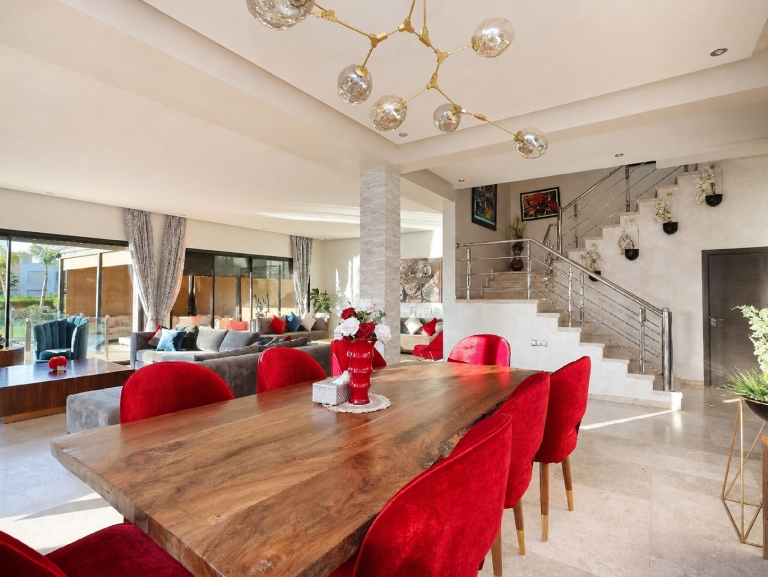
Interior decoration of Villa Prestigia in Marrakech: compare the 3D renders with photos of the finished project, from concept to delivered finishes.
View the case study
Case study
Villa Prestigia Marrakech
Interior decoration of Villa Prestigia in Marrakech: compare the 3D renders with photos of the finished project, from concept to delivered finishes.
View the case study


